How to Create a Minimal Appliance Setup

To create a minimal appliance setup, start by evaluating your cooking needs and frequency. Choose essential, versatile appliances that serve multiple purposes, like a blender that’s also a food processor. Maximize counter space by opting for items that stack or hang, and organize your kitchen for efficiency. Keep only the tools you truly use. Regularly review your appliances to guarantee they fit your cooking habits. There’s more to explore about optimizing your kitchen space effectively.
Key Takeaways
- Assess your cooking needs to prioritize versatile appliances that can perform multiple functions effectively.
- Measure your kitchen space to ensure selected appliances fit comfortably without overcrowding countertops.
- Invest in multi-functional tools, like a blender that also functions as a food processor, for efficiency.
- Regularly declutter and evaluate each appliance’s utility to remove items that aren’t frequently used or necessary.
- Organize appliances based on usage frequency, keeping essential items easily accessible and rarely used items stored away.
Assessing Your Cooking Needs
When it comes to creating a minimal appliance setup, the first step is evaluating your cooking needs.
Take a moment to think about how often you cook and what types of meals you usually make. Are you into quick weeknight dinners, or do you love experimenting with gourmet recipes? Investing in time-saving kitchen tools can significantly streamline your cooking experience.
Consider your lifestyle—if you’re often busy, you may want appliances that help you save time. Smart gadgets like multifunctional cookers can be particularly beneficial for those on the go. Also, think about if you prefer meal prepping or cooking fresh every day.
Jot down the specific tasks you want your appliances to perform, like steaming, baking, or sautéing. Understanding these needs helps you decide which appliances are truly essential, ensuring your kitchen remains functional without excess clutter.
Start from your habits, and build from there.
Choosing Essential Appliances
When choosing essential appliances, start by identifying your core needs and the types of meals you’ll be preparing. Consider how much space you have, as that’ll influence what you can realistically keep. Balancing functionality with your available space is key to a minimal setup. Additionally, incorporating multi-functional appliances can significantly enhance your cooking efficiency while saving valuable counter space. Emphasizing the importance of smart technology integration can also transform your cooking experience by offering convenience and connectivity for the modern chef.
Identify Core Needs
Although every kitchen can benefit from various appliances, it’s essential to identify your core needs to avoid clutter and maximize efficiency.
Take a moment to think about what you actually use daily. This will help you focus on the essentials that make cooking enjoyable and less stressful. Adopting a minimalistic approach can greatly enhance both your efficiency and cooking experience.
Consider these three key areas:
- Cooking Method: Decide if you need a stovetop, oven, or microwave based on your preferred cooking style.
- Food Prep: Think about tools like food processors or blenders that simplify meal prep and make cooking quicker.
- Storage Needs: Assess if your refrigerator or freezer is adequate for your grocery habits and meal plans. Additionally, consider compact cookware options that can enhance your cooking efficiency while saving space in your kitchen.
Space Considerations
To create an efficient kitchen, you’ll need to carefully consider the space you have available for your appliances. Prioritizing must-haves over nice-to-haves helps you make better choices. Here’s a table to guide you in selecting essential appliances based on size and functionality:
| Appliance | Space Requirement |
|---|---|
| Compact Refrigerator | Small footprint |
| Microwave | Can fit on countertop |
| Toaster Oven | Multi-purpose design |
| Slow Cooker | Needs cabinet space |
Measure your countertops and cabinets to visualize the layout. Choose appliances that fit comfortably, leaving room for meal prep. A well-planned setup minimizes clutter while keeping essential tools within reach, making your kitchen more functional and enjoyable. Additionally, consider the importance of energy efficiency to reduce long-term costs and make an eco-friendly choice. Furthermore, incorporating innovative gadgets can help streamline cooking tasks, ensuring that your minimal appliance setup is as effective as possible.
Prioritizing Versatility Over Quantity

Choosing versatile appliances is essential for a minimal setup, as it allows you to maximize functionality without cluttering your space. Instead of filling your kitchen with specialized gadgets, opt for appliances that can perform multiple tasks. This way, you’re not only saving space, but also simplifying your cooking process. A multi-cooker, for instance, can perform multiple cooking tasks such as pressure cooking and slow cooking, making it a valuable asset in a minimal appliance setup. Additionally, the rise of smart kitchen technology enables these appliances to enhance convenience and efficiency in meal preparation.
Here are a few multifunctional appliances to evaluate:
- Blender/Food Processor: Perfect for smoothies, soups, and chopping ingredients.
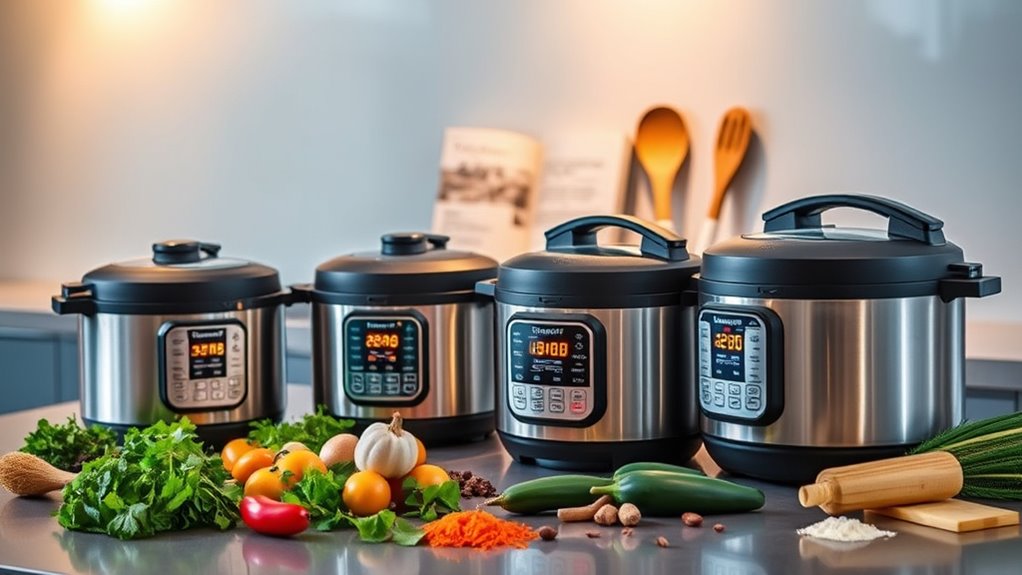
- Instant Pot: Functions as a pressure cooker, slow cooker, and rice cooker, among others.
- Toaster Oven: Works for toasting, baking, and even broiling, replacing several devices.
Maximizing Counter Space
To maximize your counter space, consider investing in multi-functional appliances that can save you both time and space.
You might also want to think about vertical storage solutions to keep your essentials within reach without cluttering your surfaces.
These strategies will help create a more organized and efficient kitchen environment.
Use Multi-Functional Appliances
While you might feel tempted to fill your kitchen with all the latest gadgets, opting for multi-functional appliances can actually maximize your counter space and streamline your cooking process.
These versatile tools help you get more done while minimizing clutter. Imagine having one appliance that serves several purposes; it’ll make your kitchen feel much more spacious and organized.
Here are some great multi-functional appliances to examine:
- Instant Pot: A pressure cooker, slow cooker, rice cooker, and steamer combined.
- Blender: A smoothie maker that also chops, mixes, and purees.
- Toaster Oven: Toasts, bakes, and broils, allowing for versatile cooking options.
Store Items Vertically
Maximizing counter space is essential for maintaining an organized kitchen, and one effective way to achieve this is by storing items vertically. Instead of laying everything flat, consider using shelves, pegboards, or wall-mounted racks.
You can hang pots and pans, which not only saves space but also adds a stylish touch to your kitchen. Use stackable containers or tiered organizers for your spices, utensils, and ingredients, allowing easy access without cluttering your countertops.
Don’t forget about the space above your cabinets; it’s perfect for storing less frequently used items. By thinking vertically, you’ll create a more functional workspace that feels open and inviting, making meal prep and cooking much more enjoyable.
Organizing for Efficiency

Organizing your appliances not only saves space but also streamlines your daily tasks.
Organizing your appliances maximizes space and simplifies your daily routine.
When everything has a designated spot, you’ll find it easier to maintain a tidy space and access what you need quickly.
Start by grouping like items together, making sure each category is easily identifiable.
- Keep everyday appliances within arm’s reach (like your toaster or coffee maker).
- Store less frequently used items in higher cabinets or tucked away.
- Label drawers or containers so you know exactly where everything belongs.
Embracing Multi-Functional Tools
When you embrace multi-functional tools, you can greatly reduce clutter and enhance your cooking experience.
Consider investing in appliances that serve multiple purposes, like a blender that also functions as a food processor. This way, you eliminate the need for separate devices, saving space in your kitchen.
Look for tools that can slice, dice, and steam, allowing you to simplify meal prep while still enjoying versatility. Remember, quality matters—choose durable tools that can handle various tasks efficiently.
Maintaining a Clutter-Free Environment
To maintain a clutter-free environment in your kitchen, it’s essential to have a clear strategy for managing your appliances and tools.
Start by evaluating what you really need. Keep only the appliances that serve a purpose or bring joy to your cooking routine.
Next, establish a designated space for each item to guarantee they’re easy to find and return after use.
Finally, adopt a routine for decluttering regularly.
- Prioritize using up any single-use items.
- Store seldom-used appliances out of sight.
- Set a monthly reminder to reevaluate your kitchen setup.
Evaluating and Adapting Your Setup
As you immerse yourself in evaluating and adapting your appliance setup, it’s essential to reflect on how often each item contributes to your daily cooking.
Start by reviewing each appliance’s utility and consider if it really aligns with your cooking habits. If an item collects dust or feels like a hassle to use, it might be time to let it go.
Evaluate your appliances; if they’re just collecting dust or causing frustration, it may be time to part ways.
You might also find it helpful to rotate appliances in and out of storage based on seasonal cooking needs. For example, if you’re grilling more in summer, maybe the air fryer can take a break.
Remember, the goal is to simplify your space while keeping what’s genuinely beneficial for your meals.
Adapt your setup until it feels just right for you!
Questions
Can I Create a Minimal Setup on a Tight Budget?
Yes, you can create a minimal setup on a tight budget. Focus on essential items, prioritize quality over quantity, and consider second-hand options. With careful planning, you’ll achieve functionality without overspending.
What Appliances Are Best for Small Kitchens?
Did you know 80% of kitchens are underutilized? In small kitchens, compact appliances like multifunctional mixers, toaster ovens, and small coffee makers work wonders. They save space while maximizing functionality, allowing you to cook efficiently.
How Do I Prevent Appliance Overload in Small Spaces?
To prevent appliance overload, you should prioritize multi-functional gadgets, declutter regularly, and only keep what you truly use. Assess your kitchen’s needs, and don’t hesitate to let go of duplicates or less essential items.
What Are Some Non-Appliance Cooking Methods?
You can explore non-appliance cooking methods like stovetop skillet cooking, open-fire grilling, slow-cooking with a pot, and baking in a Dutch oven. Each method offers simplicity, creativity, and delicious results without overwhelming your space.
How Often Should I Reassess My Appliance Setup?
You should reassess your appliance setup every six months or whenever your cooking habits change. Regular evaluations help guarantee you’re using only what you need, maximizing efficiency and minimizing clutter in your kitchen space.